
By Eric Shoemaker, Owner, Shoemaker Snoddy Roofing & Construction
TL;DR: There’s no authoritative published pricing for Dallas–Fort Worth roof replacement, and we won’t invent one. What we can tell you is how the number is built — roof squares, pitch, complexity, material and decking condition — and what’s specific to DFW: heavy hail exposure, no state roofing license to filter contractors, and no state-mandated impact-resistant discount like Oklahoma’s.
Every “average roof cost in Dallas” figure you’ll find online traces back to an aggregator estimating from national data. We work in the metroplex and we’re not going to pretend a single number describes a market that spans Highland Park to Weatherford. What follows is how to build your own number and what makes DFW different.
Why We Won’t Quote You an Average
Three reasons, and they’re not evasions.
The metroplex isn’t one market. Labor and material costs, permitting, and competitive density differ meaningfully between Dallas, Fort Worth, and the outer suburbs.
Hail cycles move pricing. After a major DFW hailstorm, demand spikes and pricing follows. A number that was accurate in a quiet spring isn’t accurate three weeks after a significant event.
And roofs aren’t comparable. A simple gable and a cut-up roof with four valleys and three dormers of identical square footage are different jobs at different prices.
An average that ignores all three isn’t information. It’s a number that feels like information.
How the Number Is Built
Roofing is priced by the square — 100 square feet of roof surface, not floor area. Your total is squares times a rate, plus what’s found under the old roof.
Roof size and pitch. Steeper roofs need staging and move slower. Two roofs of equal area with different pitches are not equal jobs.
Complexity. Valleys, dormers, chimneys, skylights, multiple planes. Every penetration takes flashing detail and time.
Material. Standard architectural asphalt is the DFW baseline. Impact-resistant shingles cost more upfront. Metal is a different tier entirely.
Decking condition. Priced per sheet, discovered at tear-off. Any honest estimate carries a contingency for it.
Layers. A second layer doubles tear-off and disposal.
Access. Tight lots, landscaping to protect, nowhere for a dump trailer.
Ask any contractor how many squares your roof is. Once you have that number, comparing estimates gets dramatically easier.
What’s Specific to Dallas–Fort Worth
Hail exposure is the dominant factor
DFW sits in one of the most hail-active corridors in the country, and major metroplex hailstorms have produced very large insured-loss events. Practically, that means a meaningful share of DFW roofs are replaced through insurance rather than out of pocket — which makes your deductible, not the total, the number that often matters.
No state license means the vetting burden is yours
Texas doesn’t license roofing contractors. After a hailstorm the metroplex fills with new companies, and there’s no state registration to check them against. We covered the substitute checks in vetting a Texas roofer — the short version is to verify insurance with the carrier directly.
This affects cost in a way people miss: the cheapest bid after a storm is frequently from the company least likely to be reachable when the workmanship warranty matters.
No mandated impact-resistant discount
Oklahoma requires insurers to offer a discount for qualifying impact-resistant roofing. Texas does not. Some Texas carriers offer one voluntarily, and it can be worth real money — but you have to ask, and the answer varies by carrier.
If you’re weighing an impact-resistant upgrade in DFW, get your carrier’s actual discount in dollars per year before deciding. Without a mandate behind it, the payback math is entirely carrier-specific.
Getting Estimates You Can Actually Compare
Get three. Insist each one itemizes:
- Tear-off and disposal, and layer count
- Underlayment type and ice-and-water placement
- Shingle manufacturer, line and impact rating
- Flashing — new or reused
- Ventilation changes
- Decking rate per sheet and sheets assumed
- Permit as a pass-through line
- Workmanship warranty length and exclusions
Then compare line by line. A cheaper total is usually a smaller scope, and the difference is generally in underlayment, flashing, and whether decking was budgeted at all.
Our residential roofing in Texas estimates are itemized on this pattern, and the inspection costs nothing.
Frequently Asked Questions About Roof Replacement Cost in DFW
How much does a roof replacement cost in Dallas–Fort Worth?
There’s no reliable published average, and figures circulating online generally come from aggregators extrapolating national data rather than metroplex records. Your cost depends on roof squares, pitch, complexity, material and decking condition. Two or three itemized estimates on your actual roof is the only way to get a number that means anything.
Does insurance cover roof replacement in Texas?
If the damage is from a covered peril such as hail or wind, typically yes, subject to your deductible and your policy terms. Whether you have replacement cost or actual cash value coverage makes a large difference — actual cash value subtracts depreciation and leaves you covering that gap. Check which applies to your roof before storm season, not after.
Are impact-resistant shingles worth it in Dallas?
Possibly, but the math is different than in Oklahoma. Texas doesn’t require insurers to offer an impact-resistant discount, so whether one exists depends entirely on your carrier. Given DFW’s hail exposure the durability case is strong on its own — just get the discount quoted in dollars before you assume it pays for the upgrade.
Why is my roofing quote so much higher after a hailstorm?
Demand. After a major metroplex hail event, every crew and every supply house is working the same storm, and pricing and scheduling both tighten. It’s also when the largest number of unfamiliar companies appear. If the roof is protected and the claim isn’t at a deadline, waiting for demand to settle is sometimes reasonable.
Do I need a permit to replace a roof in Dallas or Fort Worth?
Permitting is handled by individual cities rather than the state, and requirements differ across the metroplex. Call your local building department to confirm what’s needed at your address. Your contractor should pull the permit and show it as a pass-through cost on the estimate rather than asking you to pull it yourself.
Get a Free Roof Estimate in Dallas–Fort Worth
If you want a real number for your actual roof instead of a national average, we’ll measure it and itemize it. Shoemaker Snoddy Roofing & Construction is a licensed general contractor headquartered in Oklahoma City and working across Texas, and we bring the same documentation, insurance certificates and workmanship guarantee to both states. Call us at (405) 724-9720 or reach us through our contact form.
About the Author
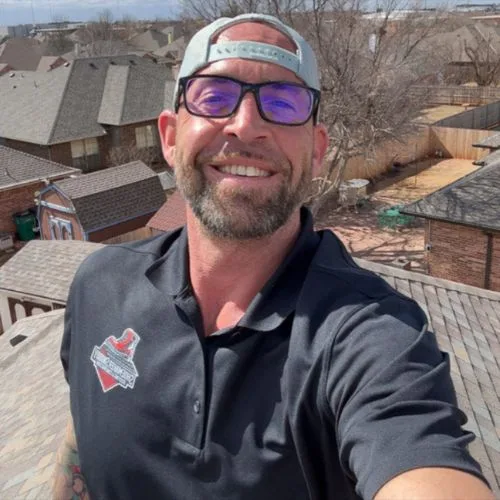
Eric Shoemaker — Owner, Shoemaker Snoddy Roofing & Construction
Eric co-owns Shoemaker Snoddy Roofing & Construction, a licensed general contractor based in Oklahoma City. He came up through roofing and construction management and works storm claims across Oklahoma and Texas.
Licensed general contractor · Oklahoma CIB registration #80007305 · 10+ years in roofing and construction
Shoemaker Snoddy Roofing & Construction
500 N Meridian Ave #202, Oklahoma City, OK 73107