
By Eric Shoemaker, Owner, Shoemaker Snoddy Roofing & Construction
TL;DR: Replacement cost value (RCV) pays what a new roof actually costs today. Actual cash value (ACV) pays that number minus depreciation for the age and wear of your old roof — and on a 15-year-old roof, depreciation can take a very large bite. In hail-heavy Oklahoma, the ACV policy is the cheaper premium and the far more expensive claim.
Two Oklahoma homeowners on the same street can take the same hailstorm, file the same claim, and end up with wildly different outcomes. The difference usually isn’t the adjuster or the contractor. It’s one line in the policy neither of them read closely: whether the roof is covered at ACV or RCV.
ACV vs. RCV at a Glance
| Actual Cash Value (ACV) | Replacement Cost Value (RCV) | |
|---|---|---|
| What it pays | Replacement cost minus depreciation | Full replacement cost |
| Effect of roof age | Large — payout shrinks as roof ages | None on the final total |
| Number of payments | Usually one | Two: ACV first, depreciation released after completion |
| Your out of pocket | Deductible plus the depreciation gap | Deductible only |
| Premium | Lower | Higher |
| Best for | Newer roofs, or budgets that can absorb a shortfall | Almost every Oklahoma homeowner with a roof past its first few years |
The row that decides it is “your out of pocket.” Under RCV you’re responsible for the deductible. Under ACV you’re responsible for the deductible and everything depreciation removed.
How Actual Cash Value Actually Works
ACV starts from the same place as RCV — what it costs to replace your roof today — then subtracts depreciation based on age and condition.
Say replacing your roof costs $18,000, your roof is 15 years into a 25-year expected life, and your deductible is $2,000. Roughly 60% of its life is used, so depreciation lands somewhere near $10,800. The insurer pays about $7,200, then subtracts your $2,000 deductible, and you receive roughly $5,200 toward an $18,000 roof.
You are $12,800 short.
Those numbers are illustrative — carriers use their own depreciation schedules and condition adjustments, so your real figures will differ. But the shape is right, and it’s the shape that matters. A 15-year-old roof on an ACV policy does not get replaced by the claim. It gets partially funded by it.
How Replacement Cost Value Works
RCV pays the full cost of replacing the roof, subject to your deductible. It arrives in two payments, which is where the confusion starts.
The first payment is the ACV portion — replacement cost minus depreciation, minus deductible. It looks alarmingly small, and homeowners regularly assume they’ve been underpaid.
They haven’t. The withheld amount is recoverable depreciation. Once the work is complete and invoiced, the insurer releases it. The two payments together cover the full replacement cost, less your deductible. Understanding this is the single most useful thing you can know walking into the claim timeline, because that first check convinces a lot of people their claim was shorted.
Why This Matters More in Oklahoma
Two reasons, and they compound.
First, our roofs work harder here. Hail and wind cycles mean an Oklahoma asphalt roof often reaches the end of its practical life faster than the number on the warranty suggests. Faster aging means steeper depreciation, which means a bigger ACV gap.
Second, hail claims here are common enough that carriers manage their exposure actively. That shows up as roof schedules that shift older roofs onto ACV, as separate and higher wind/hail deductibles, and as cosmetic damage exclusions. Any of the three can turn a claim you expected to cover a roof into one that covers a fraction of it.
The Policy Language to Check Before the Next Storm
Pull your declarations page and look for four things:
Roof settlement or roof schedule endorsement. This is where a carrier converts roof coverage to ACV past a certain age. It’s often the difference between the two outcomes described above.
Separate wind/hail deductible. Frequently a percentage of the dwelling coverage rather than a flat dollar figure, and typically higher than your all-peril deductible.
Cosmetic damage exclusion. Common on metal roofing. It means dents that don’t affect function may not be covered at all.
Recoverable vs. non-recoverable depreciation. If depreciation is non-recoverable, there’s no second payment, even on a policy that otherwise looks like RCV.
The time to read this is now, not after a storm. Coverage decisions belong entirely to your insurance company — our role in claim assistance is documenting the damage accurately so their decision is made on complete information.
Frequently Asked Questions About ACV and RCV Roof Coverage
Is ACV or RCV better for an Oklahoma roof?
RCV is better for nearly every Oklahoma homeowner whose roof isn’t brand new. Our hail and wind exposure ages roofs quickly, and ACV depreciation scales with that age — so the gap you’d have to cover yourself grows every year. ACV saves money on premium and costs far more at claim time, which in a hail-prone state is a bad trade for most households.
Can I switch my roof coverage from ACV to RCV?
Often yes, by asking your agent, though carriers commonly require an inspection and may decline based on the roof’s age or condition. This is why it’s worth asking before you need it — once a roof is old enough for ACV to really hurt, it’s frequently too old for the carrier to write RCV on it. Any change also takes effect going forward, never on a loss that already happened.
What is recoverable depreciation on a roof claim?
Recoverable depreciation is the portion the insurer withholds from the first payment and releases after the work is finished and invoiced. On an RCV policy the two payments together cover the full replacement cost, less your deductible. If your policy states depreciation is non-recoverable, that held-back amount is never paid and you absorb it.
Does my roof’s age change what my insurance pays in Oklahoma?
Under ACV, yes, substantially — the older the roof, the more depreciation reduces the payout. Under RCV the age doesn’t change the final total, though many Oklahoma policies carry a roof schedule endorsement that moves older roofs onto ACV automatically. Check your declarations page for that endorsement, because it’s the mechanism that quietly changes your coverage over time.
Why was my hail claim denied as cosmetic damage?
Some policies, especially on metal roofing, exclude damage that affects appearance without affecting function. Dents that don’t compromise the roof’s ability to shed water can fall under that exclusion. Whether a particular dent is cosmetic or functional is a coverage determination your insurer makes — what we can do is document the condition thoroughly so that call is made on real evidence.
Talk to an Oklahoma City Roofing Contractor About Your Claim
If you’re not sure whether your policy covers your roof at ACV or RCV, that’s worth sorting out before the next hailstorm rather than after. Shoemaker Snoddy Roofing & Construction is a licensed general contractor in Oklahoma City, and we’ll inspect and document your roof at no cost so you know what condition it’s actually in. Call us at (405) 724-9720 or reach out through our contact form.
About the Author
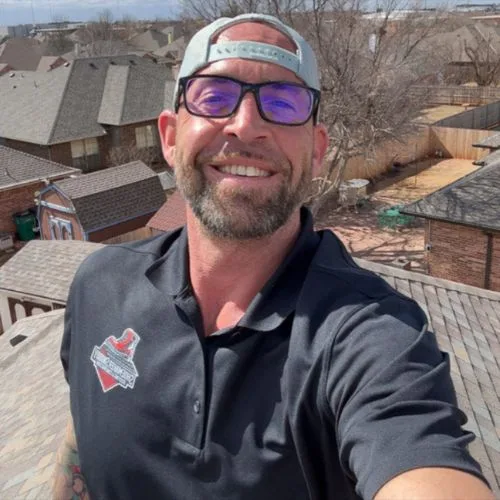
Eric Shoemaker — Owner, Shoemaker Snoddy Roofing & Construction
Eric co-owns Shoemaker Snoddy Roofing & Construction, a licensed general contractor based in Oklahoma City. He came up through roofing and construction management and works storm claims across Oklahoma and Texas.
Licensed general contractor · Oklahoma CIB registration #80007305 · 10+ years in roofing and construction
Shoemaker Snoddy Roofing & Construction
500 N Meridian Ave #202, Oklahoma City, OK 73107