
By Eric Shoemaker, Owner, Shoemaker Snoddy Roofing & Construction
TL;DR: Oklahoma’s so-called 25% rule is the threshold where a roof repair stops being a repair. As it’s commonly applied, once roughly a quarter or more of a roof section is repaired or replaced within a 12-month window, that section may have to be replaced outright and brought up to current code — and work at that scale is generally treated as licensed roofing contractor territory rather than handyman work. It’s the reason a “cheap patch” in Oklahoma City sometimes costs more than doing it properly the first time.
Ask three Oklahoma roofers about the 25% rule and you may get three slightly different answers, which tells you something: it isn’t one clean statute you can look up in an afternoon. It’s a threshold that shows up in how code upgrades get triggered and in who is allowed to do the work, and it quietly shapes the repair-versus-replace decision on a lot of Oklahoma City roofs. If you’re weighing a patch against a full replacement, it’s worth understanding before you sign anything.
What Is Oklahoma’s 25% Rule?
In practice, the 25% rule describes two related thresholds that both land near the same quarter-of-the-roof mark.
The first is about code. When repair or replacement work reaches roughly 25% or more of a roof section inside a 12-month period, the expectation is that the whole section comes off and goes back on to current code — not patched to match whatever was there before. The 12-month window matters: three separate 10% repairs across one year can add up to the same trigger as one large job.
The second is about who does the work. Work covering that share of the roof surface is generally treated as requiring a licensed roofing contractor rather than a general handyman.
A fair warning on precision: the 25% figure is widely cited across Oklahoma roofing companies, but it’s a characterization of how code and licensing thresholds get applied rather than a single quotable line of statute. Treat it as a planning rule, and confirm the specifics for your address with your local building authority before you rely on it.
The Two Thresholds People Confuse
The code-upgrade trigger
This is the one with cost consequences. Below the threshold, you’re repairing — matching what exists, replacing damaged material in kind. Above it, the section is effectively a new roof, which means current code applies to the whole thing: underlayment requirements, fastening patterns, ventilation, flashing details. Work that was compliant when your roof went on in 2004 may not be compliant now, and the upgrade lands on your bill.
The licensed-contractor trigger
Oklahoma requires roofing contractors to be registered with the state, and a homeowner can ask for that registration number and verify it before anyone sets a ladder against the house. At small repair scale, the line between trades gets blurry. At quarter-of-the-roof scale, it isn’t blurry — that’s roofing work, and the person doing it should be registered to do it.
Why a “Cheap Patch” Can Cost More
Here’s the scenario we see most often. A storm takes out shingles across one slope. A homeowner gets a low bid to patch “just the damaged part.” The patch turns out to cover more of the section than anyone measured, and now the job has crossed into replace-and-upgrade territory — except it was scoped and priced as a repair.
At that point one of two things happens, and neither is good. Either the work gets done to repair standards anyway and you have a section that doesn’t meet current code, or the scope has to expand mid-job and the “cheap” bid stops being cheap.
The fix is unglamorous: measure the actual damage footprint before pricing anything. On our residential roofing inspections we photograph every elevation and measure the affected area specifically so we can tell you which side of the line you’re on — and price both paths honestly when you’re genuinely near it.
How Permits Interact With This
If your home is inside Oklahoma City limits, there’s a second layer. Since August 1, 2025, significant residential reroofing on single-family homes and duplexes inside the city requires a permit and inspection, with a fee of $94.50 at the rule’s launch. Maintenance work of 500 square feet or less is exempt.
Notice how the two rules stack. A job small enough to sit under the 25% threshold may also be small enough to sit under the permit exemption. A job that crosses one often crosses the other. That’s not a coincidence — both are drawing a line between maintenance and reconstruction.
One important limit: that permit rule applies inside Oklahoma City limits only. Norman, Edmond, Moore, Tulsa and every other Oklahoma city set their own permitting requirements, and they are not the same. If you’re outside OKC, confirm the rule with your own city rather than assuming the OKC one applies.
What to Ask Before You Approve a Repair
Three questions will tell you most of what you need to know:
- What percentage of this roof section does the proposed work actually cover? If the contractor can’t answer with a measurement, they haven’t measured.
- If this crosses the threshold, what changes about the scope and the price? A good answer is specific. A vague one is a warning.
- Does this address need a permit, and who is pulling it? Pulling the permit is part of the job, not your homework.
Frequently Asked Questions About the 25% Rule for Roofing in Oklahoma
Is the 25% rule an actual Oklahoma law?
It’s best understood as a widely applied threshold rather than a single quotable statute. Oklahoma roofing companies cite it consistently because it reflects how code-upgrade and licensing requirements get applied in practice. Because the exact application varies by jurisdiction, confirm the specifics for your address with your local building authority before relying on it for a repair decision.
Does the 25% apply to my whole roof or just one section?
Section by section, which is the part most homeowners miss. A roof with several distinct planes is evaluated per section, so damage concentrated on one slope can cross the threshold for that slope while the roof as a whole is barely touched. That’s usually what causes the surprise.
Do multiple small repairs add up?
Yes — the commonly cited window is 12 months. Three modest repairs to the same section inside a year can reach the same threshold as one larger job. If you’ve had work done on a section recently, mention it before the next repair gets scoped.
Can a handyman do my roof repair in Oklahoma?
For genuinely small work, homeowners hire all sorts of trades. Once the job reaches the quarter-of-the-section scale, it’s roofing work and belongs with a contractor registered with the state. Ask for the registration number and verify it — a legitimate contractor will hand it over without hesitation.
What if a contractor says the rule doesn’t exist?
Ask them how they scope a repair that’s close to the threshold, and whether they measure the damage footprint. The label matters less than the practice. What you want is someone who measures before pricing and tells you plainly when a repair is about to become a replacement.
Contact Shoemaker Snoddy Roofing & Construction for Residential Roofing in Oklahoma City
We’re a licensed general contractor based on N Meridian Avenue in Oklahoma City, and every job starts with a free inspection that measures the actual damage footprint rather than estimating it from the driveway. If your repair is anywhere near the threshold, we’ll show you the measurements and price both paths so the decision is yours. Call us at (405) 724-9720 or request a free inspection online.
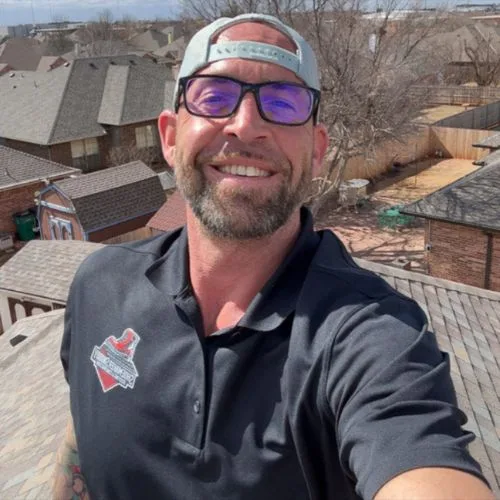
About the Author
Eric Shoemaker — Owner, Shoemaker Snoddy Roofing & Construction
Eric co-owns Shoemaker Snoddy Roofing & Construction, a licensed general contractor based in Oklahoma City. He came up through roofing and construction management and works storm claims across Oklahoma and Texas.
Licensed general contractor · Oklahoma CIB registration #80007305 · 10+ years in roofing and construction
Shoemaker Snoddy Roofing & Construction
500 N Meridian Ave #202, Oklahoma City, OK 73107